YES IF API · Private beta · 31 Oct 2026
Ship AI products
without the token bill.
One endpoint that routes, orchestrates and verifies every task. A fraction of the cost. Reliable output. Your bill stops scaling with your users.
Beta opens in
What runs underneath
- Intent & permission check0.4 ms
- Task decompositionown model
- Clause extractionmicro-model
- Cross-check vs sourceclassical compute
- Grounding & drift checkverifier
One call in. One verified result out. No frontier call unless it's the right tool.
01 · Where you are today
The model API is eating your margin.
Four numbers from 168 venture-backed AI startups. Every one of them builds on a frontier API.
46 %
Average gross margin
of AI startups, against the 77 % median of traditional SaaS
38 %
Of revenue
goes to inference and compute. In SaaS it's 6 %
5–30×
More tokens
per task the moment your product becomes agentic
1 vendor
Holds your unit economics
their price change is your margin change, overnight
You didn't build only an AI business. You built a reseller of someone else's inference.
02 · Your number
What would you stop paying?
Drag to your current monthly inference bill.
back in your margin, every year
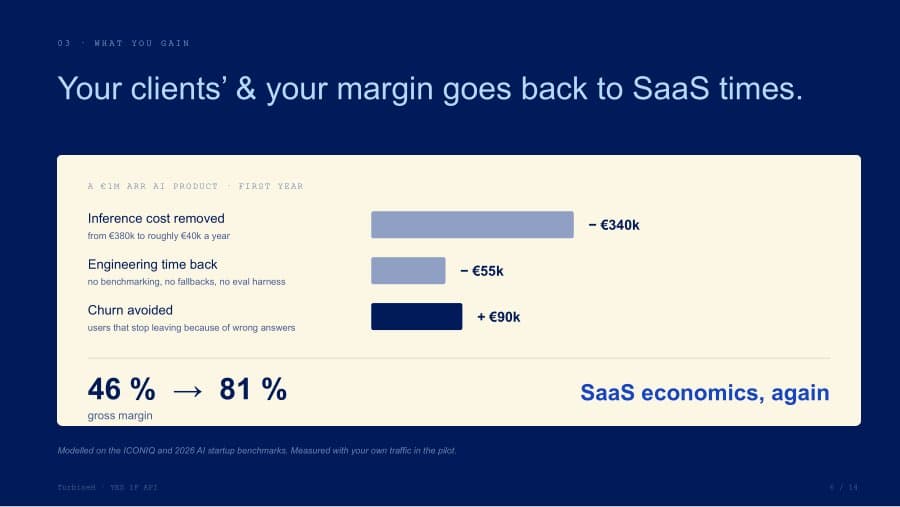
Estimate based on 2026 AI startup benchmarks (€380k → ~€40k per €1M ARR). Measured with your own traffic in shadow mode.
The product
YES IF for Builders
The orchestration layer your product runs on, with no token consumption for you.
Routes
every request to the right resource
Models, agents, micro-model swarms and plain computation.
Orchestrates
and makes them collaborate
It breaks the task down, builds the execution graph and has the pieces work together. You send intent, not a prompt chain.
Verifies
before it returns anything
Grounding, drift and quality checked on the way out. Your users never see the hallucination they would have seen.
03 · How it works
One endpoint instead of five vendors.
Step 1
Swap the endpoint
Point your existing client at our base URL. The request shape you already use keeps working.
Step 2
Declare intent
Optionally replace your prompt chain with a task and a policy. That's where the savings come from.
Step 3
Run in shadow
We mirror your traffic and show cost, latency and accuracy against your current setup.
Live
Switch over
Same contract, same SLA. Flat cost from the first day.
No migration. No rewrite. If the shadow run doesn't beat your current numbers, you don't switch.
YES IF API
What you get back
- A result
- already grounded and verified
- A trace
- which resource did what, and why
- A cost
- the same one, whatever ran underneath
- A fallback
- that never breaks your SLA
04 · Difference
Why this isn't another router.
A router moves your request. It doesn't change what it costs you or whether the answer is right.
Frontier API direct
You pay per token, and usage is your cost curve.
No token consumption. Scaling users never scales your bill.
A model router
Routes to a cheaper model. Still per token, still one model per call.
Decomposes the task and has several resources collaborate on it.
Your own eval harness
You built benchmarking, fallbacks and retries yourself.
Verification is the product, not something you maintain.
Raw model output
Whatever it said is what your user sees.
Grounding and drift checked before anything is returned.
Vendor lock-in
Their price change is your margin change.
Open models underneath. The architecture is the moat, not the vendor.
Prompt-level security
Injection is your problem to solve.
Identity, permission and injection checks before anything runs.
05 · What builders do with it
Three products. Three bills that stopped growing.
Legal tech SaaS
Before
Every contract review sent 40 frontier calls. The bill grew faster than the user base.
−94 %
inference cost per review. Same accuracy, verified output.
Agentic ops platform
Before
Each agent run fanned out to dozens of model calls with no cost ceiling.
Flat
per run, whatever the agent decides to do underneath.
Computer-vision startup
Before
Every frame was going to a multimodal frontier model. Unsustainable at scale.
€0.0004
per frame. Detection runs on edge micro-models, not on a frontier call.
Baseline figures measured with each team before switching the endpoint.
“We were burning engineering time benchmarking models, writing fallbacks and guessing next month's bill. None of that was our product.
Now it's one endpoint. It picks the resource, secures the input/output and the cost is flat.”
CTO · Checktobuild
Series A · 40k monthly users
06 · Pricing
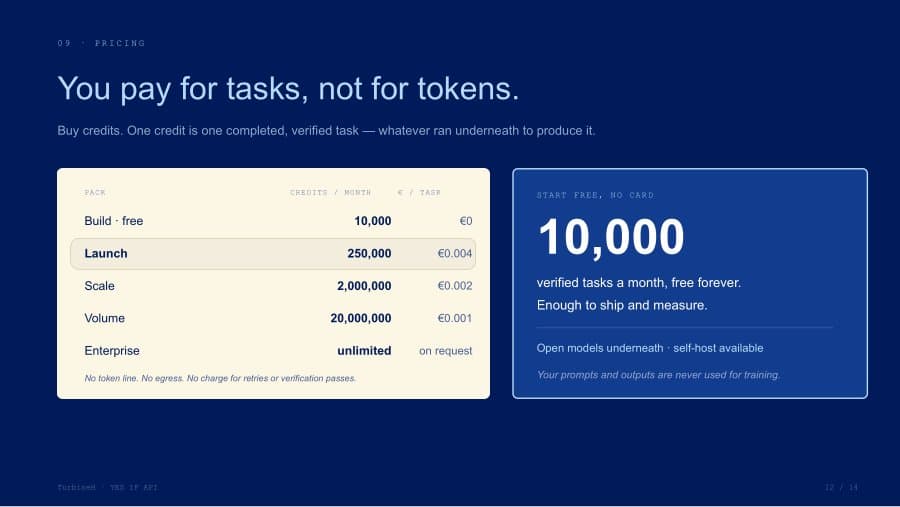
You pay for tasks, not for tokens.
One credit is one completed, verified task, whatever ran underneath to produce it.
| Pack | Credits / month | € / task |
|---|---|---|
| Build · free | 10,000 | €0 |
| Launch | 250,000 | €0.004 |
| Scale | 2,000,000 | €0.002 |
| Volume | 20,000,000 | €0.001 |
| Enterprise | unlimited | on request |
No token line. No egress. No charge for retries or verification passes.
Start free, no card
10,000
verified tasks a month, free forever. Enough to ship and measure.
Your prompts and outputs are never used for training.
Why join now
The waitlist is the fast lane.
First access on 31 Oct
Invites go out in waitlist order the morning the beta opens.
A guided shadow run
We run your real traffic in shadow with you and show the numbers side by side.
Move up the line
Every builder who joins with your link moves you 5 spots closer to the front.
The builders deck
Take the full deck with you.
14 pages: the margin numbers, how the orchestration works, the shadow-mode pilot, pricing and the FAQ. Built to forward to your CTO or your board.
- Benchmarks from 168 AI startups
- Architecture and request flow
- Pricing and the pilot plan
Leave your details once: you get the deck and your spot on the beta waitlist.

07 · Frequently asked
What every builder asks.
When can I start using it?+
The private beta opens on 31 October 2026. Invites go out in waitlist order, and referrals move you up.
Do I have to rewrite my prompts?+
No. Point your existing client at our base URL and it keeps working. Declaring intent instead of prompt chains is optional. It's just where the biggest savings are.
What if a task genuinely needs a frontier model?+
Then it uses one. The point isn't avoiding frontier models, it's not paying for one when a micro-model or plain computation does the job better.
How do I know the quality didn't drop?+
Shadow mode. We mirror your traffic and show cost, latency and accuracy side by side against your current setup, before you switch anything.
Am I swapping one lock-in for another?+
Open models underneath, self-host available and your traffic is portable. If you leave, your prompts and traces come with you.
What about latency?+
Most tasks get faster, because they stop making a round trip to a frontier model. Routing overhead is under a millisecond.
Is my data used for training?+
Never. Not your prompts, not your outputs, not your traces. European infrastructure, and self-hosting if you need it.
Get an API key
and run it in shadow
next to what you have.
Join the waitlist. We'll send your invite the day the beta opens.